 Listicle
How to Choose the Best Moisturizer for Chronic Eczema
Last Updated: November 4, 2026
Quick Summary
The best moisturizer for chronic eczema restores water to dry, damaged skin and seals it in with a protective layer that keeps irritants out. Choose a short, fragrance-free formula with proven emollients, and apply it twice a day, starting within three minutes of bathing while skin is still damp.
- Apply moisturizer within three minutes of patting dry after a bath or shower.
- Use roughly a fingertip unit of cream for each area the size of two flat palms.
- Ointments suit cracked heels and elbows, while gels suit hairy or sweaty areas.
- Look for ceramides, glycerin, petrolatum, shea butter, colloidal oatmeal, panthenol and niacinamide.
- See a doctor if eczema covers large areas, weeps fluid, crusts yellow or comes with fever.
Table of Contents
- What the Best Moisturizer for Chronic Eczema Actually Does
- How to Treat Eczema Naturally With the Right Emollient
- Natural Eczema Relief at Home: Application Timing, Frequency and Amount
- Cream, Lotion, Gel or Ointment: Matching Texture to Eczema Severity and Body Area
- Ingredients to Look For and What to Avoid in an Eczema Moisturizer
- Numbered Picks: Eczema Moisturizers Worth Comparing
- When a Moisturizer Is Not Enough: Signs You Need Medical Care
- Building Your Daily Eczema Skincare Routine With Mamatuziosoil
- Frequently Asked Questions
What the Best Moisturizer for Chronic Eczema Actually Does
The best moisturizer for chronic eczema does two jobs at once: it puts water back into dry, damaged skin and then seals it in with a protective layer that keeps irritants out. That combination is what dermatologists call barrier support, and it matters more than any single ingredient on the label.
Chronic eczema is a long-term condition in which the skin's protective outer layer stays weak, so moisture escapes and irritants get in. Mamatuziosoil's skincare is designed to heal, protect, and restore skin health. The best moisturizer for chronic eczema is the one you will actually apply twice a day, every day.
Below, we break down how to treat eczema naturally, which textures suit which body areas, and which products are worth comparing.
How to Treat Eczema Naturally With the Right Emollient
An emollient is a moisturizing ingredient that softens rough skin and fills the gaps between skin cells, and it is the backbone of any natural eczema routine. Choose one with few ingredients and no added fragrance, then apply it while skin is still slightly damp after washing.
Natural emollients fall into a few families, and each behaves differently:
- Plant butters and oils such as shea butter and olive oil, which soften skin and add a protective film
- Colloidal oatmeal, which calms itchy, irritated skin
- Petrolatum and mineral oils, which form the strongest moisture seal
A common mistake is chasing a long "natural" ingredient list. A shorter list with proven emollients usually works better for reactive skin.
Colloidal Oatmeal, Petrolatum and Mineral-Rich Clays
Colloidal oatmeal is finely milled oat that forms a soothing film on the skin and is one of the few natural ingredients widely used in eczema care for calming itch.
Our Oceanic Glacial Clay 100ml is a mineral-rich glacial clay that replenishes beneficial minerals and promotes natural rehydration. For a leave-on emollient, look for a shea butter base, like our Nature's Touch Shea Butter with CBD.
Natural Eczema Relief at Home: Application Timing, Frequency and Amount
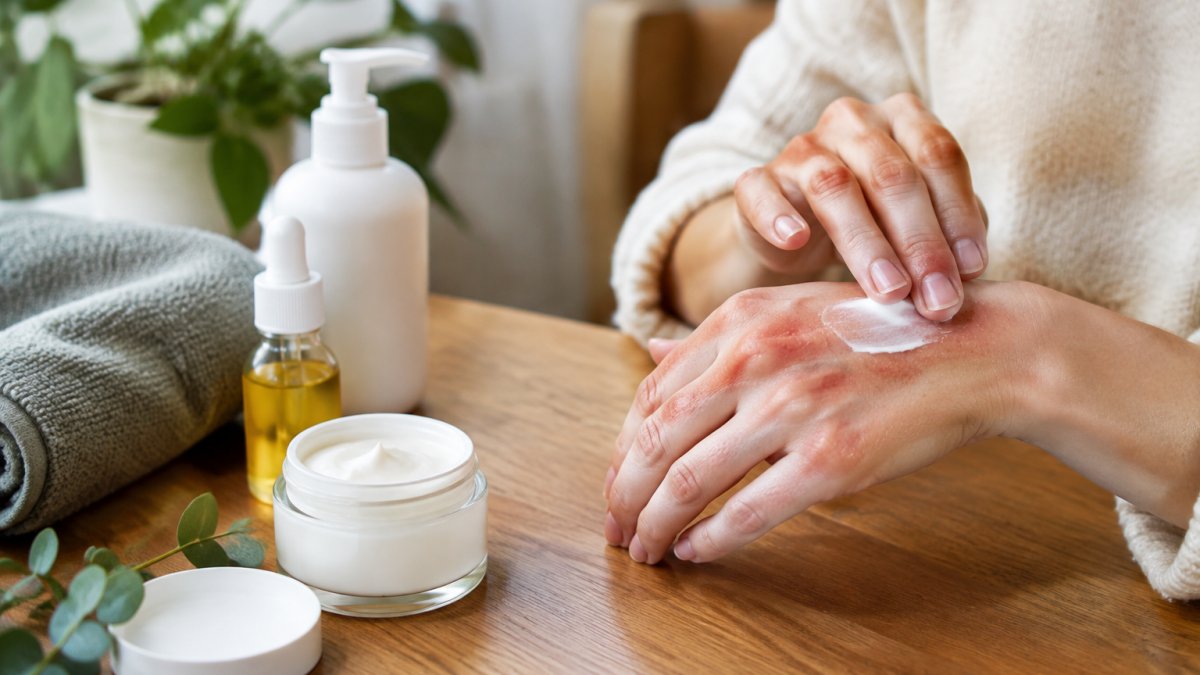
Natural eczema relief at home works best when you apply moisturizer within three minutes of stepping out of the bath or shower, while skin is still damp. Do this twice a day at minimum, and use roughly a fingertip unit of cream for each area the size of two flat palms.
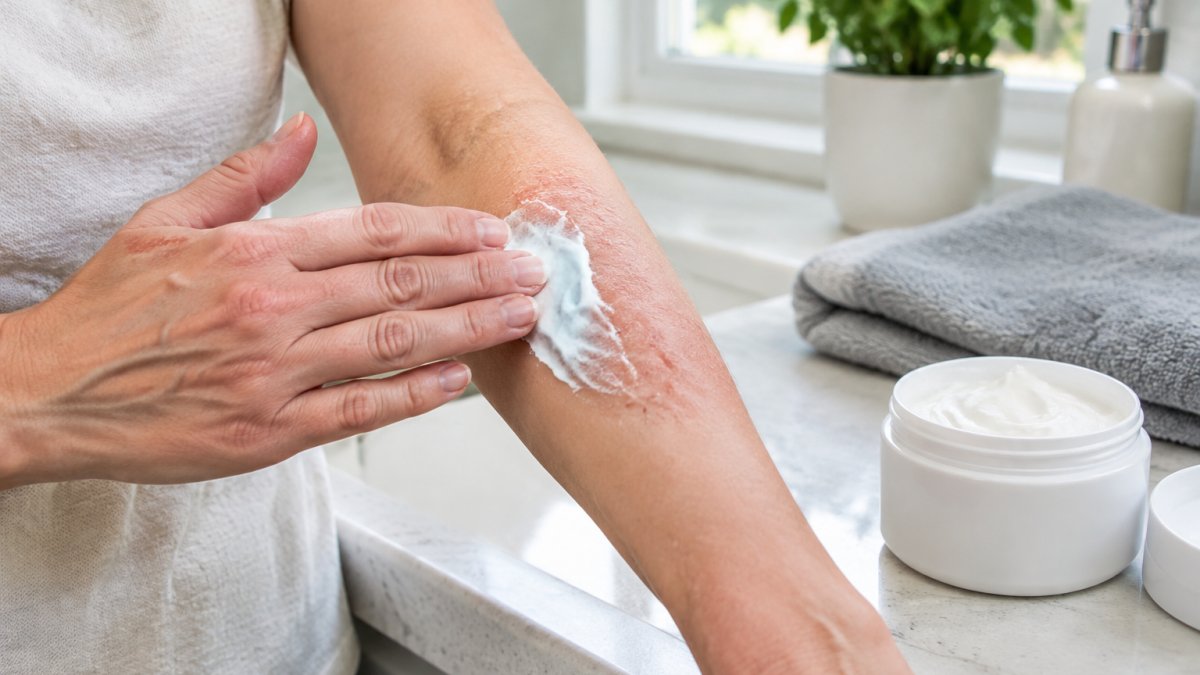
Most people under-apply. A thin sheen is not enough for chronic eczema; the cream should still be visible on the skin for a minute before it sinks in. Smooth it in the direction of hair growth, and reapply to hands after every wash.
For a quick reference, here is how the routine should look:
| Step | Timing | Frequency | Amount |
|---|---|---|---|
| Apply after bathing | Within 3 minutes of patting dry | Daily | Fingertip unit per two-palm area |
| Morning application | After washing face and hands | Daily | Thin but visible layer |
| Evening application | Before bed | Daily | Thicker layer on dry patches |
| Reapply to hands | After every hand wash | As needed | Small dab |
Cream, Lotion, Gel or Ointment: Matching Texture to Eczema Severity and Body Area
Texture should follow the body area and the severity of the flare. Ointments are the heaviest and seal best, creams sit in the middle, lotions are lightest and least occlusive, and gels suit hairy or sweaty areas where heavy creams feel uncomfortable.
Here is how to match texture to the job:
- Ointment: cracked heels, elbows, and very dry patches overnight
- Thick cream: trunk, arms, and legs with moderate dryness
- Lotion: large areas that need frequent daytime reapplication
Facial skin is thinner and reacts faster, so use a lighter cream there and patch-test anything new. Our tusc skin conditioner is a good example of a lighter formulation for readers who want to compare how a natural conditioner feels against a heavy cream.
Ingredients to Look For and What to Avoid in an Eczema Moisturizer
Humectants pull water into the outer skin layer.
Occlusives sit on the surface and slow water loss.
Emollients soften and smooth by filling the spaces between skin cells.
Barrier lipids most directly address the underlying defect in chronic eczema.
Soothing agents calm itch and redness rather than repair the barrier. Colloidal oatmeal is the best-known example and is recognized by the U.S.
A practical label filter for chronic eczema:
- Look for: ceramides, glycerin, petrolatum or dimethicone, shea butter, colloidal oatmeal, panthenol, niacinamide
- Approach with caution: fragrance (including 'natural' fragrance and essential oil blends), lanolin if you react to wool, high-concentration urea on cracked skin
- Avoid on broken or weeping skin: scrubs, alpha- and beta-hydroxy acids, drying alcohols, and anything that stings within minutes of application
Moisturizer vs. Medicated Treatment: What Ingredients Can and Cannot Do
It helps to separate moisturizers from medicated treatments, because the two are often shelved together. Moisturizers restore water and barrier lipids; they do not contain active drugs. Over-the-counter eczema products may add hydrocortisone (a low-potency corticosteroid) or other actives, and those are treatments with their own instructions and limits, not daily moisturizers.
A common pattern is to use a plain, fragrance-free moisturizer as the base of the routine and apply any medicated product only as directed, often a thin layer on inflamed patches before or after the moisturizer, depending on the product.
Fragrance, Preservatives and Contact Allergy Risks
Fragrance is one of the most common causes of contact allergy in skincare, and 'fragrance-free' and 'unscented' are not the same claim: an unscented product may contain a masking fragrance.
If a product stings, turns the skin red within minutes, or triggers a new rash, stop it and keep the ingredient list so you can compare against products that have worked.
Numbered Picks: Eczema Moisturizers Worth Comparing
Rather than rank products in a single order, it is more useful to match a product to the job: how severe the dryness is, which body area you are treating, and how often you will reapply. None of the picks below replaces a doctor's advice for severe or infected skin.
For very dry, cracked patches and overnight sealing
- Petrolatum-based ointment (for example, plain Vaseline or a store-brand equivalent). A common occlusive ointment. Best for heels, elbows, and cracked patches under a cream at night. Trade-off: greasy, not cosmetically elegant, and not ideal for large daytime areas.
- Vanicream Moisturizing Cream. A cream commonly recommended for reactive skin. Best for people who react to almost everything, and a reasonable first trial for highly reactive skin.
For moderate full-body dryness and daily maintenance
- CeraVe Moisturizing Cream (or the lighter Daily Moisturizing Lotion for daytime). The cream suits trunk, arms, and legs; the lotion suits large areas that need frequent daytime reapplication.
- La Roche-Posay Lipikar Soothing Relief Eczema Cream. A cream from a fragrance-free eczema line. Best for full-body use during flare-ups when a lotion feels too light.
- Eucerin Eczema Relief Body Cream. A cream that is widely available. Best for daily full-body care where cost per use matters.
For itchy patches and the itch-scratch cycle
- Aveeno Eczema Therapy Daily Moisturizing Cream. A colloidal oatmeal cream that targets itch. Best for calming itchy patches at an accessible price, and a good option for readers who want a single product for both moisture and soothing.
- Sarna Original Anti-Itch Lotion. A camphor and menthol lotion for fast cooling relief. Best layered under a cream during intense itch, not as a standalone moisturizer, menthol can sting broken skin.
For facial skin and hairy or sweaty areas
- A lighter facial cream or lotion from a fragrance-free eczema line. Facial skin is thinner and reacts faster, so use a lighter texture there and patch-test anything new. For scalp, chest, and other hairy areas, a gel or spray-on emollient is easier to apply than a heavy cream.
For readers who prefer a natural, plant-based emollient
- Mamatuziosoil Nature's Touch Shea Butter with CBD. A shea butter-based product. It suits adults managing chronic dryness who want a short, plant-based ingredient list. As with any new product on reactive skin, patch-test on a small area first.
How to Compare Cost Per Use and Accessibility
Chronic eczema means frequent, whole-body application, so package size and price per ounce matter more than the sticker price. A large tub of a plain cream or ointment often costs less per use than a small tube of a premium eczema cream.
If you want to see how real customers rate natural skin products before deciding, our testimonials and textimonials page collects their feedback.
When a Moisturizer Is Not Enough: Signs You Need Medical Care
See a doctor if eczema covers large areas, weeps fluid, crusts yellow, or comes with fever, because those signs point to infection or a condition that needs prescription treatment. Moisturizers manage dryness and barrier repair; they do not treat infection or severe inflammation.
Watch out: continuing to layer cream over infected skin can make things worse, so stop and get medical advice if the skin is hot, painful, or oozing. For readers also managing joint or muscle discomfort alongside their skin care, our Pain Relief Ointment - PRO- An- Algea is a targeted relief option to discuss with a professional rather than a substitute for care.
Building Your Daily Eczema Skincare Routine With Mamatuziosoil
The routine that works is boring, and that is the point: gentle wash, pat dry, moisturizer within three minutes, twice a day, plus a thicker layer on the worst patches at night. Consistency beats product hopping every time.
Mamatuziosoil makes that routine easier with 100% natural, animal cruelty-free formulas. Mamatuziosoil offers 100% natural, animal cruelty-free skincare for both humans and pets, including mineral-rich glacial clays and professional-grade options.
Get started with Mamatuziosoil and give your skin the daily barrier support it has been missing.
Frequently Asked Questions
What ingredients should I avoid in moisturizers if I have chronic eczema?
Skip anything with added fragrance, essential oils, dyes, alcohol denat and methylisothiazolinone, since these are common contact allergens for eczema-prone skin. Formaldehyde releasers such as DMDM hydantoin are also worth avoiding. Look for short ingredient lists and terms like fragrance-free and hypoallergenic. Patch test any new eczema moisturizer on a small area for 48 hours before using it on larger patches, especially if your flare-ups are frequent.
How often should you moisturize chronic eczema-prone skin?
At least twice daily, and after every bath or shower while skin is still damp. The three-minute rule matters here: apply your emollient within three minutes of patting dry, which locks in water before it evaporates. For very dry or cracked areas, add a midday application. Keep a tube at work if your hands are exposed to chemicals or water, as hairdressers and athletes often need to. Consistency beats quantity, so a thinner lotion used twice a day usually works better than a thick cream used once.
Can natural oil-based skincare help chronic eczema?
It can, when the oils are chosen for barrier support rather than scent. Oils high in linoleic acid, such as sunflower and safflower, tend to suit eczema-prone skin, while heavily fragranced oils can trigger irritation. Avoid undiluted essential oils on broken skin. Patch test first, and layer a natural oil or balm over damp skin to hold moisture in rather than relying on it alone.
What is the soak and seal method for eczema?
Soak and seal means bathing in lukewarm water for about 10 to 15 minutes, patting dry gently, then applying a thick moisturizer or ointment within three minutes to trap the water in your skin. It works because dry skin loses water fast, and an occlusive layer such as petrolatum or a rich balm slows that loss. Do it once or twice daily during flare-ups. Skip harsh soaps and hot water, which strip the skin barrier further. It is one of the most reliable natural eczema relief at home routines.