 Ultimate guide
Is Eczema-Safe Sunscreen for Sensitive Skin Worth It?
Nature's Touch - protect, heal and restore. https://mamatuziosoil.com/products/Natures-Touch-Shea-Butter-with-CBD-p625307935
Last Updated: November 4, 2026
Quick Summary
An eczema-safe sunscreen for sensitive skin is worth it because mineral formulas with zinc oxide and titanium dioxide sit on top of the skin instead of absorbing into it, so they are far less likely to sting or trigger a flare. Choose a fragrance-free, broad-spectrum SPF 30 to 50 and patch test it for 48 hours before full use.
- Chemical filters, fragrance, preservatives, and alcohol are the usual triggers of sunscreen irritation on eczema skin.
- Zinc oxide blocks both UVA and UVB, while titanium dioxide feels lighter and less greasy.
- Avoid oxybenzone, avobenzone, fragrance, alcohol denat, parabens, and essential oils.
- Patch test on the inner forearm for 48 hours, then repeat on the jawline for 24 to 48 hours.
- Wait 10 to 15 minutes after topical medication before layering sunscreen, and remove it with an oil cleanser.
Table of Contents
- Why Standard Sunscreens Trigger Eczema Flare-Ups
- Mineral Sunscreen for Eczema: How Zinc Oxide and Titanium Dioxide Differ
- Sunscreen Ingredients to Avoid for Eczema-Prone Skin
- How to Treat Eczema Naturally at Home Along with Sun Protection
- How to Patch Test and Apply Eczema-Safe Sunscreen Without Irritation
- Sunscreen Removal and Medication Interactions Most Guides Skip
- Choosing Your Eczema-Safe Sunscreen Routine with Mamatuziosoil
- Frequently Asked Questions
Why Standard Sunscreens Trigger Eczema Flare-Ups
Finding an eczema-safe sunscreen for sensitive skin starts with understanding why ordinary formulas sting, itch, and leave your skin worse than before you stepped outside. Standard sunscreens are built for normal skin, not a compromised skin barrier. When the outer layer is already cracked and inflamed, the ingredients that feel fine on healthy skin become irritants.
A common story is that someone with eczema applies a drugstore sunscreen, and within minutes the burning starts. The culprit is usually one of three things.
Chemical filters absorb into the skin to convert UV rays into heat. On an intact barrier that is fine. On a broken one, it means direct contact between reactive molecules and exposed nerve endings. Fragrance and preservatives are the second problem; they are among the most common triggers of contact dermatitis, and many mainstream sunscreens load up on both. Alcohol-based formulas are the third. They evaporate fast, which feels pleasant, but they strip moisture from skin that is already struggling to hold water.
The result is a cycle many people with eczema know too well: sun exposure, sunscreen, flare-up, more sun avoidance, then a burn when protection lapses. Breaking that cycle is the whole point of choosing a mineral formula built for reactive skin.
Mineral Sunscreen for Eczema: How Zinc Oxide and Titanium Dioxide Differ
Mineral sunscreen for eczema relies on two active ingredients: zinc oxide and titanium dioxide. Both sit on top of the skin and reflect UV radiation rather than absorbing into it. That physical action is why dermatologists often steer sensitive skin toward these filters.
Zinc oxide covers a wider spectrum, blocking both UVA and UVB rays across the full range. It also has a mild soothing quality, which is why it appears in nappy creams and barrier ointments. Titanium dioxide is excellent at UVB and short-wave UVA protection, and it tends to feel lighter and less greasy. Many mineral formulas combine the two to balance coverage and texture.
Physical Blockers vs. Chemical Filters
The practical difference comes down to reactivity. Physical blockers stay on the surface; chemical filters penetrate. For eczema-prone skin, staying on the surface means less chance of irritation. The trade-off is cosmetic: mineral formulas can leave a white cast, especially on deeper skin tones. Tinted versions solve this, though you should check the tint itself does not contain fragrance or drying alcohol.
Understanding Broad-Spectrum Protection and SPF Ratings
Broad-spectrum means the sunscreen protects against both UVA and UVB. SPF measures UVB protection only, so a high SPF without broad-spectrum coverage leaves you exposed to the aging and DNA-damaging effects of UVA. The Skin Cancer Foundation guidance on sunscreen explains that SPF 30 blocks around 97% of UVB rays, while higher ratings offer diminishing returns. For daily use on sensitive skin, SPF 30 to 50 broad-spectrum is the sensible target.
Sunscreen Ingredients to Avoid for Eczema-Prone Skin
The sunscreen ingredients to avoid for eczema fall into a short, memorable list. Check the back of the bottle before you buy.
- Oxybenzone and avobenzone: common chemical filters linked to skin irritation and allergic reactions
- Fragrance and parfum: the single most frequent trigger of contact dermatitis in cosmetics
- Alcohol denat: dries and disrupts the skin barrier
- Parabens and methylisothiazolinone: preservatives with a known sensitising profile
- Essential oils: natural does not mean non-irritating; citrus and peppermint oils commonly sting broken skin
The National Eczema Association's ingredient guidance maintains that fragrance-free, preservative-light formulas are the safest starting point for reactive skin. Watch out: "unscented" is not the same as "fragrance-free." Unscented products can contain masking fragrance to cover the smell of raw ingredients.
How to Treat Eczema Naturally at Home Along with Sun Protection
Learning how to treat eczema naturally at home works best when it supports the skin barrier rather than replacing sun protection. The two goals reinforce each other: a stronger barrier tolerates sunscreen better, and consistent UV protection prevents the sun-triggered flares that set your routine back.
Ingredients That Soothe and Nourish the Skin Barrier
Ceramides, colloidal oatmeal, shea butter, and glycerin all help rebuild the outer layer. Apply a rich moisturiser before sunscreen and give it a few minutes to absorb. For barrier support between sun exposures, a shea butter with CBD can soften dry patches, while a glacial clay mask used once or twice a week helps rehydrate and replenish minerals in stressed skin. A lightweight natural skin conditioner works well for daily softening without heaviness.
How to Patch Test and Apply Eczema-Safe Sunscreen Without Irritation
Patch testing is the step most people skip, and it is the one that prevents a full-face flare.
Stage one: the inner forearm. Apply a small amount (about the size of a pea) to the inner forearm, cover it with a bandage, and leave it for 48 hours without washing the area.
Stage two: the jawline or behind the ear. If the forearm test is clear, repeat the process on a small area of the jawline or behind the ear for another 24 to 48 hours.
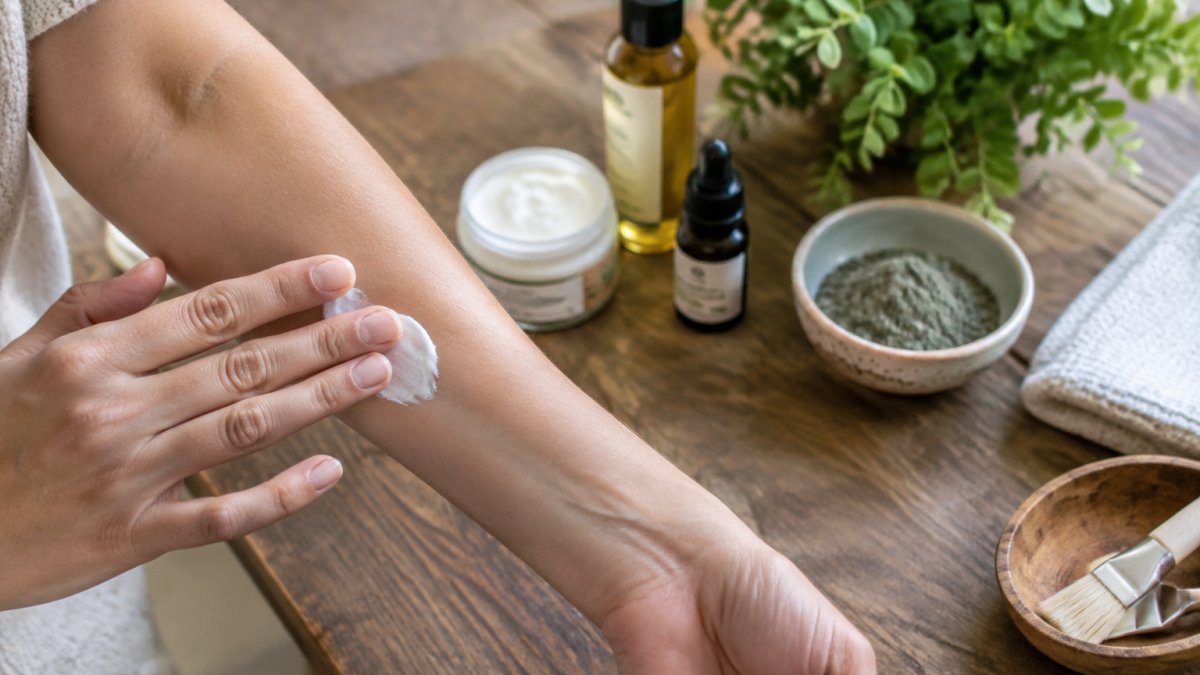
Application matters as much as the product. On eczema-prone skin, the goal is to minimize friction and avoid trapping heat. Press the sunscreen into the skin with a light patting motion rather than rubbing it in circles.
Watch out: applying sunscreen directly over an active topical treatment (steroid cream, calcineurin inhibitor, or medicated moisturizer) without waiting for it to dry can dilute the medication and increase irritation.
Reapplication every two hours outdoors is standard, but on eczema-prone skin, reapplication can be a trigger point. If your skin is already irritated, a mineral stick format allows you to dab without rubbing. Avoid spray sunscreens entirely during a flare, the propellants and alcohol in many sprays sting broken skin, and the mist can be inhaled.
A common pattern is that people test a sunscreen once, have no immediate reaction, and then use it liberally on the face, only to flare two days later. The delayed reaction is the one patch testing is designed to catch, which is why the 48-hour window matters more than the immediate sting test.
Sunscreen Removal and Medication Interactions Most Guides Skip
Two issues get almost no coverage in standard guides, and both matter for anyone managing eczema. This section goes deeper than most because these are the pain points that determine whether a sunscreen routine actually works long-term.
Layering Sunscreen Over Prescription Treatments
Many people with eczema use topical corticosteroids, calcineurin inhibitors (such as tacrolimus or pimecrolimus), or prescription moisturizers. These treatments can thin the skin or increase sun sensitivity, which changes how you should approach sun protection. The general rule most dermatologists follow is: medication first, sunscreen second, with time between.
Apply your topical treatment to clean, dry skin and wait at least 10 to 15 minutes for it to absorb fully. Then apply sunscreen over the top. If you apply sunscreen immediately after a steroid cream, you dilute the medication and may spread it to areas that do not need treatment. For calcineurin inhibitors, which can cause a burning sensation when first applied, layering sunscreen too soon can intensify that sting.
Watch out: some topical steroids and calcineurin inhibitors increase photosensitivity, meaning your skin burns more easily than before. Ask your dermatologist whether your specific treatment changes your sun-protection plan, do not assume your usual SPF is enough. If you are on a course of treatment that thins the skin, you may need to reapply sunscreen more frequently or use a higher SPF than you normally would.
Gentle Removal Without Triggering a Flare
Mineral sunscreens are designed to resist water and cling to the skin, that is what makes them effective. But that same tenacity means scrubbing them off can irritate a flare. The goal is to dissolve the sunscreen rather than scrub it away.
Start with a fragrance-free oil cleanser or a plain carrier oil (such as squalane or mineral oil) massaged gently into dry skin. Follow with a soft, damp cloth, not a scrub brush or exfoliating mitt, and wipe gently. Then use your regular fragrance-free cleanser to remove any residue. Skip abrasive exfoliants entirely during a flare; they create micro-tears that make the next sunscreen application sting.
A common pattern is that people switch to a mineral sunscreen, love the protection, but then abandon it because removal feels like a chore. Building a removal routine that takes two minutes and does not require scrubbing is what makes mineral sunscreen sustainable for daily use. If your skin is particularly reactive, keep a dedicated soft cloth and oil cleanser near the sink so removal is not a barrier to consistent use.
Choosing Your Eczema-Safe Sunscreen Routine with Mamatuziosoil
A workable routine beats a perfect product list. Here is how we would structure it:
Step | What to Do | When |
|---|---|---|
1 | Apply moisturiser or barrier cream | Morning, 10 minutes before sun |
2 | Patch test any new sunscreen | 48 hours before first full use |
3 | Apply broad-spectrum mineral SPF 30-50 | 15 minutes before going outside |
4 | Reapply | Every 2 hours outdoors |
5 | Remove with oil cleanser | Evening |
Best for: reactive, eczema-prone skin that flares with chemical filters. Skip if: you need a completely invisible finish with zero white cast; tinted mineral formulas are the better fit.
Before committing, read the testimonials and textimonials from customers who manage sensitive skin daily.
Frequently Asked Questions
Is mineral or chemical sunscreen better for eczema-prone skin?
Mineral sunscreen for eczema is generally the safer starting point. Zinc oxide and titanium dioxide sit on top of the skin as physical blockers rather than absorbing into it, so they are less likely to cause skin reactivity or irritation. Chemical filters can sting broken skin and are more likely to trigger contact dermatitis in people with a compromised skin barrier. That said, no filter is universally safe, so patch testing a small area first remains the practical way to confirm how your skin responds.
What ingredients should I avoid in sunscreen if I have eczema?
Watch for oxybenzone, octinoxate, avobenzone, and octocrylene, which are common chemical filters linked to irritation. Also check the label for added fragrance, essential oils, alcohol denat, and preservatives like methylisothiazolinone, all of which can set off flare-ups on sensitive skin. Choose fragrance-free, hypoallergenic formulas labeled non-comedogenic, and keep the ingredient list short so there is less to react to.
How do I stop sunscreen from triggering an eczema flare-up?
Patch test on your inner forearm for 48 hours before full application. Apply moisturizer first so the skin barrier is supported, then smooth on a mineral sunscreen without rubbing hard. Reapply every two hours with a light patting motion rather than dragging. At the end of the day, remove it gently with a fragrance-free cleanser and follow with an emollient or ceramide-rich moisturizer to restore the barrier.
Can I use sunscreen while applying topical steroids for eczema?
Yes, but sequence matters. Apply your prescribed topical steroid first and let it absorb fully, usually 15 to 30 minutes, then layer mineral sunscreen over the top. Avoid chemical filters on areas where the skin is broken or freshly treated, since absorption increases there. If you are unsure how your medication interacts with a specific formula, ask your dermatologist before regular use.
Sunscreen should protect your skin, not punish it. If every formula you try leaves you itchy and inflamed, the problem is usually the ingredient list, not your skin. Mamatuziosoil builds 100% natural, cruelty-free skincare designed to heal, protect, and restore the barrier, with mineral-rich clays and nourishing oils that work alongside your sun routine. Get started with Mamatuziosoil and give reactive skin the protection it has been missing.